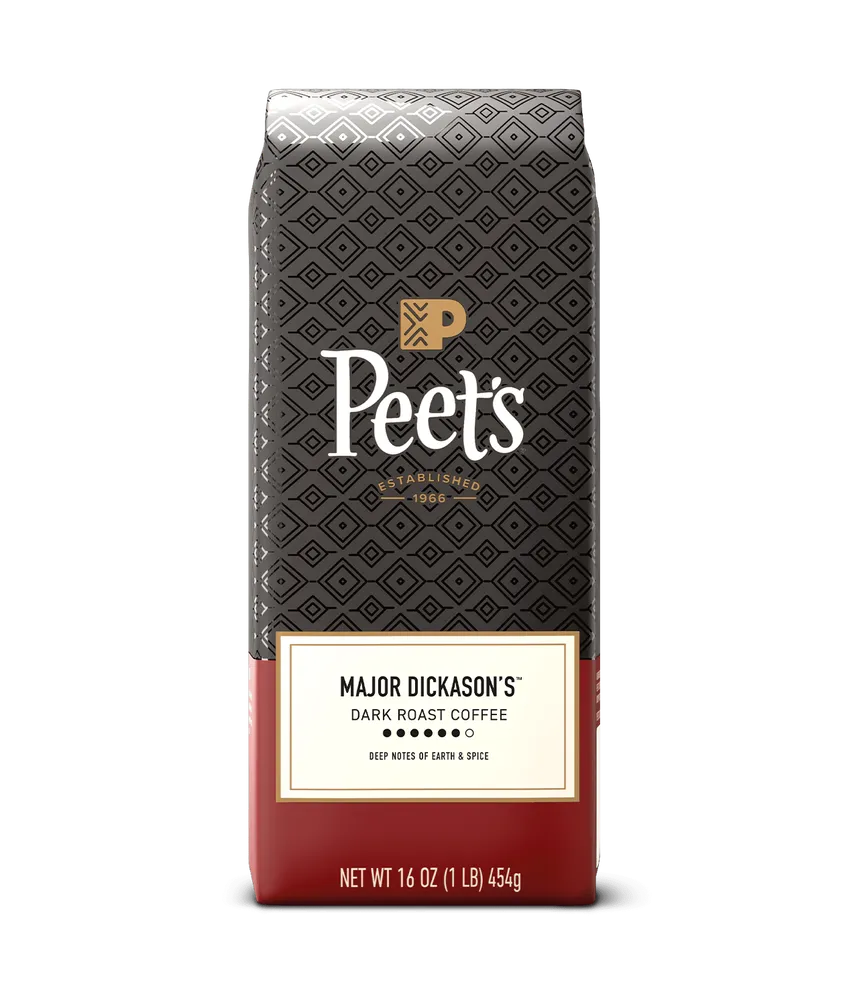
Source-reported notes · Dark roast
Listed in stock · Checked October 21, 2026
Keep this coffee as your reference while you explore the taste landscape.
A dark-roasted Arabica blend with Peet’s earth and spice descriptors. Compare a chocolate-led blend or Vietnamese robusta, keeping roast labels separate from predictions about taste.
Where to buy
Peet’s Coffee
Listed in stock when checked
Checked October 21, 2026. Price and stock may change.
View coffee at the roaster ↗Price and delivery details
Delivery eligibility and charges at the roaster checkout.
The coffee data sheet
Coffee at a glance.
- Species
- Arabica
- Origin
- Multiple origins
- Region
- Not supplied
- Process
- Washed and Wet-Hulled
- Roast
- Dark
- Farm / producer
- Not supplied
- Variety
- Not supplied
- Altitude
- Not supplied
- Harvest
- Not supplied
- Lot identifier
- Not supplied
Source-reported facts · Unknown harvest and lot details remain unknown.
A dark-roast starting point
Use Major Dickason’s as a reference if a documented dark roast and earth-and-spice direction describe what you want to keep. Peet’s product page identifies a signature blend from the Americas and Indo-Pacific, with washed and wet-hulled processing. That makes it a recognizable blend reference, not an identified single farm or harvest.
For a next coffee, decide which part matters more: keeping the darker roast, or moving toward another flavor description. These two alternatives make that choice explicit. We have not tasted them side by side.
Two alternatives to explore
Big Trouble: change the flavor direction
- What stays familiar: Big Trouble is another multi-origin Arabica blend with a source label toward the darker end.
- What changes: Counter Culture calls it medium-dark and describes chocolate, caramel and nutty notes. It is a route toward those descriptors, rather than an earth-and-spice replacement. Source: Counter Culture.
- What is unknown: Different roasters’ labels do not establish a measured roast gap, equal body or lower bitterness. Big Trouble’s captured processing and exact lot remain unknown.
Hanoi: keep a dark label and change species
- What stays familiar: Hanoi also has a roaster-reported dark roast.
- What changes: Nguyen identifies Vietnamese robusta and lists figs and graham cracker, rather than Peet’s regional Arabica blend and earth/spice references. Source: Nguyen.
- What is unknown: This is not a controlled roast comparison or a prediction of identical flavor. We have no matched-lot tasting or measured caffeine per serving for these coffees.
Compare Major Dickason’s, Big Trouble and Hanoi
Keep Major Dickason’s as your starting coffee on the landscape
The diamond marks your reference while you inspect another coffee.
Buying observation: 21 October 2026
Peet’s public product data marked the whole-bean option available when checked. This is a dated listing observation, not a checkout, shipping or roast-date guarantee. Confirm your format, current price and delivery at the retailer. A continuing blend name does not identify an unchanged crop or composition.
No native cupping assessment is recorded here. The editorial-interest estimate measures documented detail, not how good the coffee tastes; character estimates remain untested. Browse Peet’s coffees or explore earth-and-spice descriptors.
The documented profile
The notes above are attributed descriptors, not measured flavor intensities. See the sources below.
Flavor families classify the listed descriptors; they are not intensity or quality scores. Character bands below explain what is documented and what is still unknown.
On the taste landscape
Where this coffee sits.
Full map scale · Up to twelve nearby profiles. Display offsets match the full map; hollow dots use estimated roast positions. Proximity describes flavor and roast placement, not quality or identical taste.
- Ethiopia Shefina Highlands ↗
- Mexican Dark Roast Coffee - USDA Organic, Reserve ↗
- Uzuri African Blend® ↗
Earth, Spice support a mixed editorial placement. This is a comparison aid, not a measured flavor intensity. Roast uses the roaster’s relative label “Roast: Dark”, normalized to the broad Dark band.
Keep Major Dickason's™ as your reference on the full map ↗Reading the cup
Coffee character.
The outlined band shows the reported or estimated level. These describe the cup; higher is not better.
Roast level
Reported- Light
- Medium-light
- Medium
- Medium-dark
- Dark
Placed at the roast band given by the source. This is a label, not an instrument-measured roast color. Source ↗
What does roast level mean?
The roast degree of the bean; separate from sweetness, body and quality.
Acidity
Estimated · low confidence- Gentle
- Moderate
- Bright
A darker roast without fruit-led descriptors suggests gentler brightness as a working hypothesis. This needs tasting confirmation. Reference for estimate ↗
What does acidity mean?
The perceived brightness or tartness of the cup, not a quality score.
Sweetness
Estimated · low confidence- Subtle
- Noticeable
- Pronounced
Without explicit sweet-associated descriptors, we provisionally expect subtler sweetness. Absence from the notes is weak evidence, so this estimate needs tasting. Reference for estimate ↗
What does sweetness mean?
How strong the sweet impression feels. Sweet-sounding notes can inform a guess, but do not measure its intensity.
Body / mouthfeel
Estimated · low confidence- Light
- Rounded
- Full
We provisionally expect a fuller texture from the darker roast profile. Roast does not determine mouthfeel; brewing and the actual sample may change this. Reference for estimate ↗
What does body / mouthfeel mean?
The perceived weight and texture of the coffee, separate from roast darkness.
Finish
Estimated · low confidence- Brief
- Sustained
- Lingering
A sustained finish is our low-confidence baseline in the absence of a duration description. The notes and processing do not establish how long the flavor lasts; tasting may move this band in either direction. Reference for estimate ↗
What does finish mean?
How long the flavors remain after a sip, rather than how good they are.
Coarse descriptive bands, not laboratory measurements or cupping category scores. Brewing changes the cup. Missing descriptions receive low-confidence editorial guesses, which can change after tasting.
Evidence & context
Where this review starts.
Original editorial writing from attributed public information. This coffee has not been tasted by robusta.co. Brewing suggestions, where included, are untested starting points unless stated otherwise.
Checked October 21, 2026.
Checked October 3, 2026.
Updated October 21, 2026. Missing lot identity remains unknown. A historical score never automatically applies to a later offering.
Follow the flavor
Other coffees with similar taste profiles.
Connections from documented notes, species, processing, and editorial map placement; not predictions of identical taste.
Explore from this coffee ↗